Are you a small organization being asked by a larger client to prove your security, and need help from a NIST cybersecurity framework guide? You’re in the right place.
Whether you’ve just received a vendor security questionnaire asking about your NIST framework alignment, or your board wants documentation of demonstrable security maturity, the NIST Cybersecurity Framework provides the structure you need.
It’s not a compliance mandate. There’s no “NIST certification” to achieve. Instead, it’s a practical framework that helps you organize, document, and improve the security controls you likely already have in place.
This guide explains what NIST framework implementation actually means for Canadian small businesses, how you can use Microsoft 365 to address framework requirements, and how to document your security posture when opportunities require it.
Let’s dive in.

NIST is the National Institute of Standards and Technology, a non-regulatory agency within the United States Commerce Department. While primarily US-based, NIST guidelines have achieved international recognition and are widely used by Canadian organizations for security framework implementation.
The NIST Cybersecurity Framework (CSF) is a voluntary framework that provides guidance on managing cybersecurity risk. It was created in response to Executive Order 13636 and initially focused on critical infrastructure, but has since been adopted by organizations of all sizes and industries.
The framework is based on effective cybersecurity practices from multiple standards bodies and industry sources, making it a practical, flexible approach to security management.
NIST Cybersecurity Framework (CSF): A voluntary framework for managing cybersecurity risk, suitable for organizations of any size.
NIST Special Publication 800-171: Requirements for protecting Controlled Unclassified Information (CUI) in non-federal systems.
Note: Many Canadian businesses also reference ITSG-33, which is the Canadian government’s IT security framework offering baseline guidance similar to NIST publications. Both frameworks serve complementary purposes within Canada.
This is where many businesses get confused, so let’s be clear about what NIST actually is.
NIST is NOT a Compliance Mandate.
The NIST Cybersecurity Framework is a voluntary framework, not a regulatory compliance requirement. There is no such thing as “NIST certification” or “passing NIST compliance.”
You cannot get certified in the NIST Cybersecurity Framework the way you can achieve ISO 27001 certification or SOC 2 attestation. NIST provides guidelines and best practices that organizations can choose to adopt.
When businesses say they’re “NIST compliant,” what they really mean is that they’ve implemented security controls aligned with NIST framework recommendations. The correct terminology is:
Understanding this distinction matters:
These are laws. If you are in a regulated profession with IT compliance requirements, you must comply or face legal consequences.
These are recommendations. You choose to adopt them for best practices in data security and to pass vendor security screenings. Examples include:
Even though NIST is voluntary, many organizations require their vendors and partners to demonstrate NIST framework implementation. When a client asks “Are you NIST compliant?”, they’re really asking “Have you implemented security controls that align with NIST recommendations?”
You can demonstrate NIST framework adoption through:
Some organizations do face NIST requirements:
For most Canadian small businesses, NIST is a voluntary framework you adopt because it:
The NIST Cybersecurity Framework gives you structure for two critical needs:
The NIST CSF is also one of the most cost-effective approaches to structured cybersecurity management.
Working with the NIST Framework, you can:
Most small businesses lack dedicated security staff. The NIST Framework provides structured guidance without requiring extensive in-house expertise, helping you
implement proven security practices without hiring a full security team.
The NIST Framework’s guidelines can be implemented comprehensively or selectively. Small businesses can choose the most appropriate categories and subcategories based on their risk profile and resources. You might start with a small number of controls, then expand coverage as you grow.
This flexibility is essential since the Framework recommends setting a “target profile” to work toward from your “current profile,” identifying gaps and addressing shortcomings systematically.
NIST framework implementation often satisfies vendor security screening requirements and supports compliance with other regulatory frameworks. Many organizations require their vendors to demonstrate NIST-aligned security controls.
Failing to implement adequate security frameworks can result in:
Reputation damage: Clients increasingly expect documented security practices. Security incidents damage reputation, and many jurisdictions require public disclosure of data breaches.
Lost business opportunities: Businesses unable to demonstrate security maturity struggle to pass vendor security screenings, particularly when pursuing contracts with larger organizations or government entities.
Increased risk exposure: Without structured security management, organizations face higher likelihood of successful attacks and greater potential impact from security incidents.
When you can document NIST-aligned controls, vendor security screenings become straightforward instead of deal-killers. The framework’s international recognition
means Canadian and US clients both understand what you’re demonstrating.
Remember: NIST framework implementation doesn’t ensure complete security. It’s a risk management approach that helps you identify, protect against, detect, respond to, and recover from cybersecurity incidents based on your specific risk profile.
The NIST Cybersecurity Framework has three main components:
1. Framework Core
2. Framework Profiles
3. Implementation Tiers
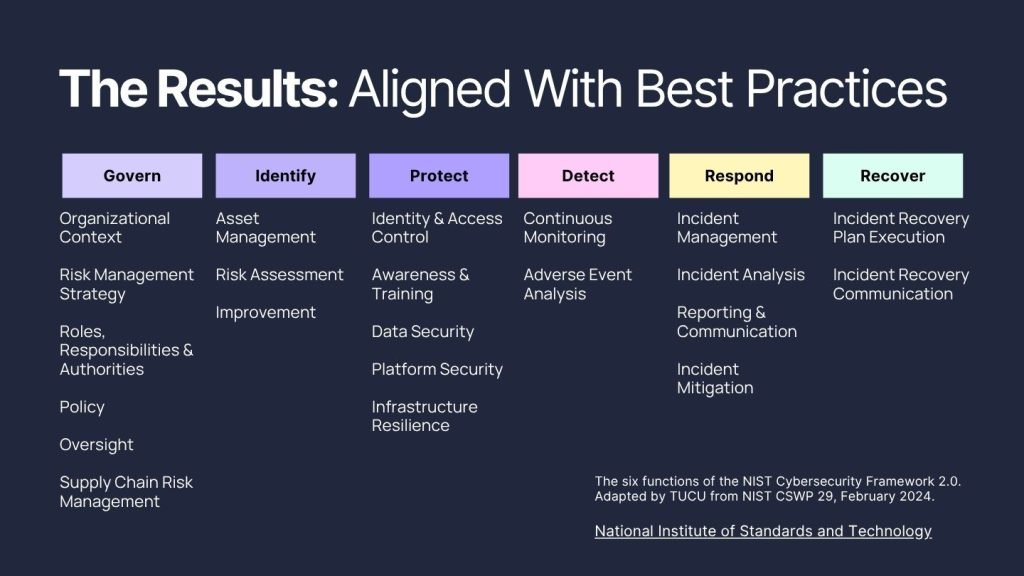
NIST released version 2.0 of the Cybersecurity Framework on 26 February 2024. The most significant change was structural. Governance was pulled out of the Identify function and made a function of its own, bringing the core from five functions to six (NIST, 2024)
If you were working from an older guide, or an older consultant, this is the change that matters. Each function contains categories, and each category contains subcategories with specific implementation guidance.
The organization’s cybersecurity risk management strategy, expectations, and policy are established, communicated, and monitored.
Categories:
The organization’s current cybersecurity risks are understood.
Categories:
Safeguards to manage the organization’s cybersecurity risks are used.
Categories:
Possible cybersecurity attacks and compromises are found and analyzed.
Categories:
Actions regarding a detected cybersecurity incident are taken.
Categories:
Assets and operations affected by a cybersecurity incident are restored.
Categories:
Framework Profiles help organizations align framework implementation with business requirements, risk tolerance, and resources.
Your Current Profile represents your current cybersecurity posture: what controls and processes you have in place now.
Your Target Profile represents your desired cybersecurity posture: what controls and processes you want to achieve.
The gap between Current and Target profiles helps you prioritize security investments and improvements.
NIST provides industry-specific profile examples:
Tiers describe how deeply integrated cybersecurity risk management is within an organization’s overall risk management practices. They range from Tier 1 (Partial) to Tier 4 (Adaptive). Most small businesses start at Tier 1 or 2 and work toward Tier 3. Tier 4 represents mature security programs typically found in larger organizations or those in highly regulated industries.


Every other function on this page maps to something you can switch on in your Microsoft 365 tenant. Govern does not. It asks who decided, who is accountable, what the policy says, and when somebody last checked. No licence answers those questions. This is the function most small businesses skip, and it is the one a vendor security questionnaire asks about first.
Nobody enjoys this part. Writing down who approves a new user account feels like paperwork invented to slow you down, right up to the week an enterprise client asks you to prove it and you have three days to answer.
What Microsoft 365 does support:
→ Microsoft Purview Compliance Manager maps your configuration against a framework and shows where you stand.
→ Microsoft Secure Score gives you a measurable posture number to review on a schedule.
→ Audit logs across Microsoft 365 provide the evidence that oversight actually happened.
→ Entra ID role assignments document who holds which administrative authority.
What it does not do:
Decide your risk tolerance. Name your accountable person. Write your policy. Review it. Those are decisions, and decisions belong to your leadership.
This is the work we do as your vCIO. We hold the framework mapping, keep the documentation current, and bring you the decisions that need making rather than leaving them until a questionnaire forces them.
NIST publishes a free Small Business Quick-Start Guide for CSF 2.0 if you want to start on your own (NIST, 2024)
Asset Management
– Microsoft 365 Admin Center provides visibility into licensed users, devices, and services
– Microsoft Intune offers complete device inventory and management
– Entra ID maintains user and application inventory
Risk Assessment
– Microsoft Secure Score identifies security gaps and provides improvement recommendations
– Microsoft Defender for Cloud Apps (CASB) identifies shadow IT and risky cloud application usage
– Security assessments can be generated showing current security configuration
Includes Identity Management, awareness training, data security controls and information protection processes, maintenance and protective technologies.
Identity Management and Access Control:
– Entra ID provides centralized identity management
– Multi-Factor Authentication (MFA) protects against account compromise
– Conditional Access policies enforce context-aware access controls
– Privileged Identity Management controls administrative access
– Single Sign-On (SSO) reduces password sprawl
Awareness and Training:
– Microsoft 365 supports delivery of security awareness training
– Attack Simulation Training provides phishing simulation and training
– Security awareness content can be distributed through Teams, SharePoint, or email
Data Security:
– Sensitivity Labels classify and protect data based on content
– Data Loss Prevention (DLP) prevents inappropriate data sharing
– Encryption protects data at rest and in transit
– Azure Information Protection provides persistent data protection
– Rights Management controls document access and usage
Information Protection Processes:
– Retention Policies enforce data lifecycle management
– Records Management supports regulatory retention requirements
– eDiscovery capabilities support investigation and legal hold
– Audit logs track access to sensitive data
Maintenance:
– Microsoft handles infrastructure patching and updates
– Microsoft Intune manages endpoint updates and compliance
– Configuration policies enforce security baselines
Protective Technology:
– Microsoft Defender for Endpoint provides endpoint protection (EDR)
– Exchange Online Protection and Defender for Office 365 provide email security
– Safe Links and Safe Attachments protect against malicious content
– Anti-malware and anti-phishing protection are built into the platform
Includes anomalies, monitoring and detection processes.
Anomalies and Events:
– Microsoft Defender for Cloud Apps detects anomalous behavior
– Entra ID Protection detects risky sign-ins and compromised identities
– Defender for Endpoint detects endpoint threats and suspicious activity
Security Continuous Monitoring:
– Microsoft 365 Defender provides unified security monitoring
– Security Operations Center (SOC) capabilities through Microsoft Sentinel
– Real-time alerts for security events
– Audit logs track user activity across Microsoft 365 services
Detection Processes:
– Alert policies can be configured for specific security events
– Automated investigation and response capabilities in Defender
– Threat intelligence integration provides context for detected threats
Includes response planning, communications, analysis, mitigation, and improvements.
Response Planning:
– Microsoft 365 Incident Response capabilities coordinate security incident response
– Playbooks and automation through Microsoft Sentinel
– Integration with IT service management tools
Communications:
– Microsoft Teams provides secure communication during incidents
– Privileged communications can be protected with sensitivity labels
– Audit trails document incident response activities
Analysis:
– Advanced hunting capabilities in Microsoft 365 Defender
– Attack investigation tools show attack progression
– Threat analytics provide context for detected threats
Mitigation:
– Automated remediation capabilities in Defender
– Account blocking and password reset capabilities in Entra ID
– Device isolation capabilities in Defender for Endpoint
– Email remediation in Defender for Office 365
Improvements:
– Microsoft Secure Score tracks security improvements over time
– Incident documentation supports lessons learned
– Security posture trends show improvement progress
Recovery Planning:
– Microsoft 365 backup and recovery capabilities
– Version history and recycle bins for data recovery
– Exchange Online retention and recovery features
Communications:
– Microsoft Teams for crisis communication
– Communication compliance to ensure appropriate messaging
– Public communication capabilities through approved channels
Improvements:
– Post-incident review capabilities
– Documentation of lessons learned
– Security configuration adjustments based on incidents
Microsoft 365 NIST framework capabilities vary by license tier:
For most Canadian small businesses implementing NIST framework Business Premium provides sufficient capabilities. E3 adds advanced compliance features for regulated industries. E5 includes advanced threat protection and insider risk management.
The key to NIST framework implementation with Microsoft 365 is proper configuration and ongoing management. Simply purchasing licenses doesn’t provide security. You must configure policies, enable protections, and maintain the environment.
Working with experienced Microsoft 365 security consultants helps ensure proper configuration aligned with NIST functions, documented policies and procedures, staff training on security features, ongoing monitoring and maintenance, and evidence of control implementation for vendor screenings.
Implementing the NIST Framework involves various costs that vary significantly based on your organization’s size, current security posture, and specific requirements.
Implementation costs depend on:
NIST framework implementation typically includes:
Initial Assessment: Comprehensive evaluation of current security posture, asset inventory, risk identification, and gap analysis.
Implementation and Remediation: Security tool deployment, policy development, control configuration, staff training, and documentation creation.
Ongoing Management: Continuous monitoring, policy updates, periodic assessments, security awareness training, and framework maintenance.
Two organizations of similar size can have drastically different implementation costs. A team of 5 using Microsoft 365 Business Premium with organized data requires far less investment than a 35-person team migrating from Google Workspace to Microsoft 365 while implementing data classification from scratch.
Your specific situation, including your current tools, security maturity, data organization, compliance requirements, and staff capabilities determine actual costs.
Many organizations focus on implementation costs while overlooking the cost of inadequate security:
Organizations that implement security frameworks often recover costs through won contracts, avoided incidents, and improved operational efficiency.
Implementing the NIST Cybersecurity Framework doesn’t require starting from scratch. Most organizations already have some security controls in place. The framework helps organize, improve, and document what you’re doing.
Start by establishing your Current Profile: document existing security controls, policies, and tools you currently use. Then define your Target Profile based on your risk tolerance, business requirements, client expectations, and available resources. The gap between these two profiles shows you what needs improvement.
Create a realistic implementation roadmap with quick wins you can achieve in the first month, short-term improvements over 3-6 months, and longer-term projects extending beyond that timeline. Prioritize gaps based on actual business risk and impact rather than trying to implement everything at once.
As you implement controls, document everything. Configure security tools, develop policies, train staff, and validate that implementations work as intended. Vendor screenings and security assessments require evidence of control implementation. Thorough documentation demonstrates your security posture when opportunities arise.
Framework implementation is ongoing, not a one-time project. Monitor security metrics, review and update policies regularly, conduct periodic risk assessments, and adjust controls as threats evolve. This continuous improvement approach keeps your security posture aligned with changing business needs and emerging risks.
Small and medium businesses typically work with IT security consultants for assessment and planning, or engage Managed Service Providers for implementation and ongoing management. The right partner brings experience implementing frameworks for similar organizations, understands Canadian regulatory context, and provides both strategic guidance and practical implementation support.
Yes, it can, and it is used widely here. NIST is a United States government agency, and the framework is voluntary guidance that any organization in any country can adopt. Canadian businesses meet it most often when an enterprise client, an insurer or a partner asks how their security is structured. It does not replace your PIPEDA obligations, which are law in Canada. The two work together.
At TUCU Managed IT Services, we’ve helped Canadian businesses implement security frameworks since 2003. We translate NIST requirements into practical Microsoft 365 configurations and help document your security posture for vendor screenings and compliance requirements.
Ready to discuss NIST framework implementation for your business? Contact us for a consultation.
